American Mythology, Men, and Morality


“I have spent my life judging the distance between American reality and the American dream.”

– Bruce Springsteen

I was introduced to Bruce through Elizabeth Wurtzel. At thirteen, strolling the aisles at the local Barnes and Noble bookstore chain with my family in tow, waiting for a table at the Italian restaurant chain around the corner. A suburban shopping center in a western American town, the kind where if you’ve seen one, you’ve seen them all. Her face beckoned me from the shelf like divine intervention. I returned her gaze as though through a mirror: her hollow sloe eyes, messy long dark hair, baggy, nondescript ’90s clothing, and distant, vacant expression all stared back at me from the cover, where the black-and-white photograph that contained her had been dramatically ripped apart and stitched back together. Prozac Nation: Young and Depressed in America. I didn’t have a clue what Prozac was, and I hadn’t given much thought to America yet, but you’d be hard-pressed to find two more suiting adjectives than ‘young’ and ‘depressed’ to describe me at this age — and well, I was in America, so I suspected that might have something to do with it.

By some miracle, my parents didn’t review my book selection that evening and purchased it for me without a second glance. It truly was a miracle, because I’m convinced that had they read the cover, it would have been sent immediately back to the shelf. By this time, they were highly attuned to my disposition toward any media and paraphernalia that would validate my depression, having already confiscated my Nirvana albums, the copy of The Virgin Suicides I stole from the library, and my collection of sharp objects. As soon as that book passed from the cashier back into my hands, I stowed it away like a thief in the night. For the next year, I carried the memoir around with me everywhere I went like my personal bible. I read it cover to cover, and backwards and forwards until I knew every scene by heart, and in the years to come, I’d revisit it again and again, like a dear old friend.

One quickly loses track of how many times Elizabeth tries to kill herself within those pages, but the point really is that she was trying equally hard to live. Somehow, as a thirteen-year-old girl, I knew, even though I didn’t have a way to make sense of it, I understood in my bones that that’s what everyone was getting wrong. The attraction to darkness wasn’t to seek a void but to seek a way through. I didn’t want to die; what I wanted was to live — to somehow rectify these two polarities which my child’s brain couldn’t hold simultaneously. For this, Elizabeth didn’t quite have the words either, but she was trying, and in her trying, Bruce seemed to be helping her along the way. So logically, I thought I’d better consult him as well. It was through Bruce that I came to understand America, freedom, masculinity, and raw pain.

At this time, I’d never been further east of Colorado in the USA, and Bruce, like Elizabeth, was from a faraway fantasy land called New Jersey. From both of their narrative fragments, I could only gather that New Jersey was a smaller, poorer version of New York, comprised of resourceful immigrant families and working-class white natives who all reached their peaks in high school and spent the rest of their lives trying to relive those days. For all intents and purposes, it didn’t seem too dissimilar from my drab reality in the suburbs of Denver — but a world apart, because in New Jersey there were mythical men in sleeveless t-shirts who rode motorcycles and picked up sad, lonely girls in the middle of the night, promising nothing for tomorrow or even for today, except a little hope, life, and if you’re lucky, something real between your legs.

The first album I could get my hands on was Born to Run. The connection wasn’t immediate, the songs were missing something my millennial teenage sensibilities were accustomed to, but I persevered and kept pressing play on my little discman as though it were a lock on a door that if I could just maneuver open would hold an answer. It first latched on with the droning harmonica, next with “Roy Orbison’s singing for the lonely / Hey, that’s me and I want you only / Don’t turn me home again / I just can’t face myself alone again, the key met the lock with, “You can hide underneath your covers and study your pain / Make crosses from your lovers, throw roses in the rain / Waste your summer praying in vain,” turned a little with, “My car’s out back if you’re ready to take that long walk / From your front porch to my front seat / The door’s open but the ride ain’t free,” and finally jiggled open with, “Oh, someday, girl, I don’t know when / We’re gonna get to that place / Where we really wanna go and / we’ll walk in the sun / But ’til then, tramps like us / Baby, we were born to run.”

With that, the lock was broken. In each ballad composed like an anthem I could taste it so strongly, almost grasping it in front of me: a freedom beyond all the countless invisible, contradictory wars relentlessly encircling and engulfing me as a young girl trying to grow up in America. The war between men and women, the war between rich and poor, moral and immoral, freedom and servitude. Somehow, in the impassioned delirium brought on by his chants, the noises of wars were silenced, if only just for a few moments — finally the sounds of the individual could be heard, and when they did, the loudest voice that emerged was that of men.

Bruce’s men are not moral, but neither are they necessarily immoral. They take wrong turns on the highway, meet a girl at a dive bar, and leave their wife and children forever. They work construction and court underage girls into running away with them until her brothers track them down and throw him in jail. Coming full circle, he simply returns to his manual labor existence to repeat the cycle. They drive south to pick up small-town girls who don’t know any better, luring them with money to spend on a big night and eloquent sweet nothings like, “It’s a long night and tell me what else were you gonna do.” They’re mad and aching and sneak into girls’ houses with bad desires asking if their daddies left them all alone.

Yet in the same breath they give us everything, “Little girl you’re so young and pretty / Walk with me and you can have your way.” They tell us of the edgy, dull knives piercing their souls, the ones they want to take to cut the pain from their hearts. They see through us and tell us to keep the faith, if nothing else but for the sake of it, never overpromising, “Well now, I’m no hero, that’s understood / All the redemption I can offer, girl, is beneath this dirty hood.” They don’t ask anything in return from us but everything, and nothing in between. They call a spade a spade and know love is tough, challenging us to be rough enough to try it. They bring a hammer and vise to pry open our hearts, knowing all along our elusive qualities, and that, lying deeper below yet, exists a secret garden of Eden, which they can only access by being led by us alone. Still, through it all they question if these roles are real or just a thrown-on fiction, pleading, “God have mercy on the man / Who doubts what he’s sure of.” But without fail in the middle of the night, when the freight trains are coming for their heads, they reach for only us, at last giving us a little promise to take us higher.

And I loved them for all of it. I loved them for their unapologetic freedom, for their life, their movement, their refusal to sit back and watch life pass them by — ready to destroy or cast away anything that blocked their path or forced a reality upon them they could not reconcile. I loved them for their lust, often not directed singularly but expressed as a part of their life force, thus giving it a quality of purity beyond what my world up until then had force-fed me to believe about sexuality. I loved them for their harshness in the face of their fate, so clearly fabricated to withstand a life under constant pressure of class struggles to protect their delicate cores: “Is a dream a lie if it don’t come true / Or is it something worse?” I loved them for their vulnerability, reflecting back my own torn, bruised, and yearning heart with uncanny perception.

Most of all I loved them for their honesty. Their desire to have their women and leave them too. Their contented reveling in blue-collar living but always demanding more. Their dreams of idyllic homes and families while keeping the car full of gas for a quick escape that could call at any moment. Their howling declarations of love that never go so far as to profess to know what love is or if itself is real. Their unshakable faith and hope in the future which even so doesn’t prevent them from waking up in cold sweats in the middle of the night.

Putting on my headphones and listening to Bruce was like flinging off all the raging wars within and without, laying them bare on the tarmac to expose their falsely constructed dichotomies. It was simply as easy as getting dressed up and hitching a ride on the back of one of their suicide machines, to leave all those hopeless, lost battles in the dust. “Together we could break this trap / We’ll run ’til we drop, baby, we’ll never go back.”

Now, decades later, I ask myself again what the missing piece is that his tracks lack which sets them a tone apart from the music released in my lifetime, since the early 90s. To what do I owe the piercing nostalgia and hunger for abandon that floods over me every time I hear him sing? It comes to me that perhaps it’s these very wars, wars which in our globalized, digitized, over- processed, produced, politicized, and polarized world have become impossible to escape in virtually every aspect of our lives. It is the weight of these wars which is missing from Bruce’s music — and the absence of this weight is filled doubly by the expression of the triumph of the present moment.

Bruce’s songs have become synonymous with working-class America, representing an America where men and women take their lot in life but work hard for their moments of stolen freedom and the possibility of a higher freedom that might be attained somewhere out there in the open lands, or by the dirt under their fingernails and the skin of their teeth. They portray the innocence of going to the carnival on a Friday night with your baby, riding all the rides, knowing someday you’ll wear each other’s rings, an all-American summer night — fireworks and freedom, stars and stripes, and making out beneath the bleachers just for the kicks. But they don’t stop there, if you know what to listen for, the darkness at the edge is also revealed, “Born down in a dead man’s town / The first kick I took was when I hit the ground,” and “I had a brother at Khe Sanh fighting off the Viet Cong / They’re still there, he’s all gone.”

But does this America truly exist? Did it ever? I grew up in this America. I have looked for this America — on the backs of motorcycles, on Greyhound buses, in 24-hour diners, at traveling carnivals, in dark city backstreets, and on cross-country road trips from New England to Tennessee to California and everywhere in between. I’ve searched for it in the faces of gas station attendants, construction crews, church going families, bus drivers, teenagers on the 4th of July, and couples holding hands on boardwalks from Santa Monica to Boston. Even pursuing it on the lips of the sad-eyed man who traveled across the country overseeing the building of service station canopies with whom I shared one too many drinks with due to a delayed flight out of Montana, and in the bed of the Silverado-driving cowboy displaced in Denver, his wife and kids waiting for him back in Oklahoma.

Though I can’t say I ever found it. What I did find, however, was the myth of this America — a mythology constructed and perpetuated by Bruce’s cutting through the red tape of the forced trap of labels, always defining, categorizing, appropriating, branding, and managing. These proliferating systems of our current consumer-driven society which steal our private moments, not simply by demanding our time, but perhaps more significantly by using our attention to manipulate and distort our perceptions with what eventually comes out in the wash as only muck. If we are not diligent and constantly on the watch, the noise can get so loud it rings in our ears long after we’ve turned it off, coming to magnify every moment of our lives through the lens of war — always over-promising and under-fulfilling.

The America Bruce describes I dare say never existed, and still doesn’t exist. Yet it is the myth of it which has the potential to come to our aid, take back our stories, and give us back our freedom through the profound knowing that we were never meant to choose one state of being to the exclusion of the other — to cut through the noise and give us back to ourselves.

Bruce says the dogs on Main Street howl because they understand if we could take one moment into our hands — I say that this is the promise land, the myth, the moment, the myth of the moment. Freedom is allowing oneself to hold all these conflicting paradigms at the same time and bravely declaring them whole, or maybe even just good enough for this moment — then riding into the storm and letting everything “that ain’t got the faith to stand its ground” blow away.

Standard

Mountains, mirrors, and portals

Tignes, France

I understand now why people say the mountain air is healing. Stepping foot off the train I immediately felt cleansed, but the remnants are still sticking to me. The unfamiliarly of every aspect of this atmosphere making me feel like a dried up fish out of water, too soon after being a fish out of water in an unforgiving place.

So here I sit, in the hotel lobby past midnight with a glass of white wine, long past everyone has gone to sleep with my laptop so I can feel something familiar. Sitting cross-legged with my fingers on the keys, trying to find the right words to express the chaos that is another day of existence.

Thinking I could be a hotel night manager, people at night are something different, reduced to their basic more needly selves, and you can have grace, like the man who poured this drink. His manner was calm all throughout even when interrupted by several impatient guests at the front desk demanding one thing or another.

Right now none of the answers are clear but I need something kind, and I think I’m somewhere kind now.

New people, I don’t know who they are, I try to let them unfold before me. I realize trying to categorize people to find where you can fit with them is a defense mechanism for self-protection and the categorization only in turn applies the same to you and prevents change.

Yet when people tell you who you are it is always intoxicating, whether it’s what you want to hear or not. If you ever want power over someone just tell them often who they are, they will lap up every word. But I don’t want to make people lap anymore, I don’t want power, I only want connection.

Still I don’t know what I’m doing here, a ski resort in the southeast of France having dinner with jetset strangers, or so they would like to have you think. But as I’ve said countless times I stopped keeping track. Is that just what happens past a certain point in life? You realize your delicately made plans don’t result despite your best intentions, and it’s all more out of your control than you could ever imagine? Ok, I know, who am I kidding, I never made plans and I’m still incapable. As long as there’s another hotel lobby for me to loiter and another kind stranger’s arms to feel around me occasionally, and if I’m lucky a good story, or hope of it — I can find a reason to wake up tomorrow.

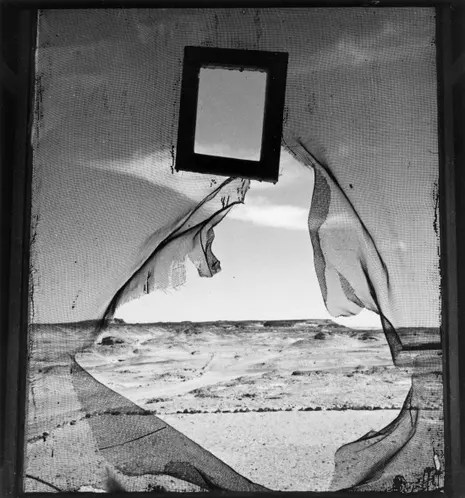
The more people I meet the less self-perception I have. Perhaps this is the attraction to be a lifelong wander. Every person is a mirror, we all know, but what if they’re also something else? A portal? An opening perhaps, a tear in the fabric. Like Lee Miller’s photograph of the tear in the mesh leading to the desert landscape. We like to think of life as some development of steps and actions leading to reactions, but in reality it’s a never ending unfolding web that occurs every breath we take.

They’re all little tears from which we catch a glimpse of another world. Another self, another other. Another landscape not traversed. Another heart ungraspable. Another climate. Other words. Kinder words. More brutal words. Another world that cuts deeper. Maybe something permanent. Maybe something soft. Maybe something cruel. Maybe something hidden, only waiting for you to find it. When he looks at you from the other end of the table trying to figure you out, sizing you up to see if you’re worthy of an apple. But you’ve seen that look before so you look away casually. But some you haven’t. Another look is out there maybe, keep your eyes open — except for when you’re dreaming, in which case keep them tightly shut.

Image: “Apposite …” Portrait of Space by Lee Miller. Photograph: © Lee Miller Archives

Standard

Solitude and other horrors

“Instead of obtaining myself by fleeing, I find myself forsaken, alone, tossed into a dimensionless cubicle, where light and shadow are quiet ghosts. In my interior I find the the silence I seek. But in it I become so lost from any memory of a human being and of myself that I make this impression into the certainty of physical solitude. If I were to scream – already without lucidity I imagine – my voice would receive the same, indifferent echo of the walls of the earth.”

– Clarice Lispector, Near to the Wild Heart

Sometimes the solitude feels like a life-sentence and all the pacing feels hollow. The walls the chairs the scenery — it all feels so dull and permanent and shallow and not even Brahms can stir some romanticism me. It’s just Don Henley singing Desperado, “Freedom, oh freedom well, that’s just some people talkin’. Your prison is walking through this world all alone… Why don’t you come to your senses? Come down from your fences?”

Fucking bastard. You come to your damn senses Don.

But he’s always talking about the devil and that speaks to me, even at times like this, especially at times like this. Where is he? That little red demon? How much does he want? What’s the asking price? Take my soul, it’s yours, I’ve had enough of it. Take it away. Do what thou wilt with it.

I think of Cincinnatus C in Invitation to a Beheading, sentenced to death but never to know the exact hour, made to wait in a cell indefinitely until the day of his beheading to wait and think and go mad. He writes, “I am here through an error – not in this prison, specifically – but in this whole terrible, striped world; a world which seems not a bad example of amateur craftsmanship, but is in reality a calamity, horror, madness, error – and look, the curio slays the tourist, the gigantic carved bear brings it’s wooden mallet down upon me.”

What a comforting thought, to be in reality only a tourist on this massive spherical rock and thus sentenced to death for not fitting into the grand design. To never have been a real part of it all and thus relinquish all responsibility for the dispassion of it all, the dirt, the sterilization, the perpetual cycles of maintenance — and for what?

I think of Peggy Lee singing, “I know what you must be saying to yourselves, if that’s the way she feels about it why doesn’t she just end it all? Oh, no, not me, I’m not ready for that final disappointment.”

Even as a child I was never haunted by death so much as how sickening it would be when it finally came and I found that in fact it is not climactic at all — just routine like everything becomes sooner or later. Still sometimes it’s only this horrifying thought which keeps me from wandering bridges alone at night or standing too close to the edge of the train platform.

Is this all there is? You see them all, on all the screens, what are they all doing in there? Little busy bees in a little box doing all sorts of things, producing, performing, talking, running, going god knowns where but they’re just there, projections in a little hand-held box, and presumably they’re also out there somewhere on this obscene hurling rock. And you’re here, wherever this is, here where the dimensions have gone flat and even the ghosts are staying quiet today. Of course you’re in the little box too, but it’s too late for that talk tonight.

And then I remember Peggy, “If that’s all there is my friends, then let’s keep dancing. Let’s break out the booze and have a ball.” And today maybe that means cheating on the moon and crawling into bed already, let the search for meaning clock out early this once. For isn’t Patti Smith always saying, “Tomorrow something wonderful might happen.

Standard

Secrecy: Hieroglyphics and indecipherable codes

“The little girl’s sense of secrecy that developed at prepuberty only grows in importance. She closes herself up in a fierce solitude: she refuses to reveal to those around her the hidden self that she considers to be her real self and that is in fact an imaginary character: she plays at being a dancer like Tolstoy’s Natasha, or a saint like Marie Leneru, or simply the singular wonder that is herself. There is still an enormous difference between this heroine and the objective face that her parents and friends recognize in her. She is also convinced that she is misunderstood: her relationship with herself becomes even more passionate: she becomes intoxicated with her isolation, feels different, superior, exceptional: she promises that the future will take revenge on the mediocrity of her present life. From this narrow and petty existence she escapes by dreams.”

– Simone de Beauvoir, The Second Sex

“Being a woman, she still felt it necessary to pose conditions; to withdraw herself further into secrecy as this man encroached.”

– Lawrence Durrell, The Alexandria Quartet, Balthazar

I have this deviant little fantasy, this manipulative abstract scene that plays sometimes in my head. Someone is ruffling through piles of papers on a desk, they are searching for me but I’m sitting right in front of them. They’re throwing the papers around trying to get to the bottom of the piles, trying to arrange them in such a way that they make sense. They grow aggravated and they shout at me “Who are you?!” “Where are you?” “Why don’t you show yourself?” “Stop playing this game!” “You are here somewhere, you have to be!” “Tell me, what is the meaning of all this? I demand to know!”

I’m all those papers with scribbles and text and black and white prints piled high on every surface, lining the walls. But I’m also sitting in the middle of the room, starring blankly back at them with my big brown sloe eyes and a neutral appeasing grin. The idiotic pathetic grin of a check-out girl who just wants her shift to end and has resigned herself for the next few hours before she’s off the clock and can be her real self again, acknowledge her emotions again. You can’t penetrate the thick exterior she threw on like a uniformed cloak to get through those wasted hours that she trades for a handful of dimes. My grin makes them even more flustered and exasperated.

They desperately shake me and grab hold of my hands and pry my fingers open to find nothing, they open my eyelids wide and peer into my ears and look deep into my mouth and down my throat, they lift up my arms to see if I’m hiding anything under there and they glare at me and search my body over with their gaze hoping something will reveal itself.

Oh but how reality can be even stranger than fiction.

It almost happened to me exactly that way once. At a hotel restaurant in Palm Springs in August, having dinner. There where the desert is more than 100° during the day; and while most people escape there in the winter, he took me there to celebrate my birthday in the middle of the summer. We drove the two hours from Los Angeles in his vintage black Porsche, hardly saying a word — anyways I hate talking in cars and the windmills were so big and the temperature was so high that the air above the tarmac quivered before us on the wide open road and thus the scenery really required all of my attention — surely you can understand.

We took a room in a Spanish Colonial-style hotel built in the 1930s, around the corner from the art museum, he knew my tastes well. The walls and the floors were either stone or tiled with mosaics. He always liked me best in hotels, airports, train stations — every time we met it was in a hotel bar or train station lobby or short-rental apartment, always a transitory space. But that night the hotel restaurant wasn’t that of our hotel’s — even from our hotel we had to venture to another transitory place. Some nights we could go to three, even four different hotels in one evening. A glass of champagne there, a Negroni there, a few tumblers of choice whisky there, a nightcap from the mini-bar in his room later.

I digress, back to the Ace hotel restaurant in Palm Springs. I don’t like Ace hotels, they try too hard to be interesting, it only makes them unbearably banal.

We sat across from each other in the booth, like we had done so many times already that summer. I couldn’t think of anything to say, I probed every nook and cranny of my mind — nothing. I searched the room over for an original remark to make, I bit my lip, I hoped and prayed that something would surface. “Say something, what is wrong with you, why don’t you say anything, think of something — anything,” my mind barked orders at me. He was going on about something, something about his mother, his childhood, I listened attentively, like I always do. Perhaps not as attentively as I thought, because suddenly I looked up from my plate and the reprimands weren’t coming from the voice in my head anymore but the man in front me. Had I stayed silent for so long I had passed the threshold and finally gone mad? No, it was real, he was repeating the orders back at me — him sitting across from me, in flesh and blood.

He was there before me throwing the papers around the room, violently inspecting all my bits, “Where are you?” “Show yourself!” “Say something!” “Stop this now!” “You can’t go on like this!” But how can you stop the absence of something, which by its very nature isn’t there to begin with? Is the opposite of fire water, or is it the absence of fire? I don’t know, but I can tell you either way it doesn’t feel good to get burnt. It didn’t feel even a little bit good hear him say those things.

But it’s not about good or bad here, and my father once told me there’s nothing inherently wrong with being misunderstood. And the secrets and the solitude, do we hold onto them to preserve our sense of self, or to extinguish our flames and make ourselves smaller than we need to be? Whatever the reason, I know I’m not the only one. Why it’s a tale as old as identity itself, manifold myths and books and poems have been written about it.

It even rear’s its perplexing head in pop culture. The Zombies singing, “Well, let me tell you ’bout the way she looked / the way she’d act and the color of her hair / her voice was soft and cool / her eyes were clear and bright / but she’s not there / Please don’t bother tryin’ to find her / she’s not there.”

Cohen’s immortal melody, “There was a time you let me know / what’s really going on below / But now you never show it to me, do you?”

Standard

Somewhere: Between sheets

“Freedom isn’t enough. What I desire doesn’t have a name yet.”

– Clarice Lispector, Near to the Wild Heart

I once wrote that I’ll know I’m free of you when I stop listening to your song to fall asleep. When I stop searching for your arms in everyone who shares my bed, stop searching for your sideways glances — always appearing to look just beyond me, too afraid or uninterested to look directly at me. When I stop digging back into the depths to feel again that imprint that is us together, like a small relief left on a down cushion. We were an imprint, you and me. It’s all you let us be and really all we could be. I know that now. We were something beyond time, only to exist in a liminal space, not fit for the relentless rhythm of life.

I don’t think of you anymore to fall asleep. I think of my white room somewhere in Greece, or Spain, or maybe Portugal or Italy — I haven’t decided yet. For some reason it’s always in Greece when I visit it, the only country of the list I haven’t been to, perhaps that’s why.

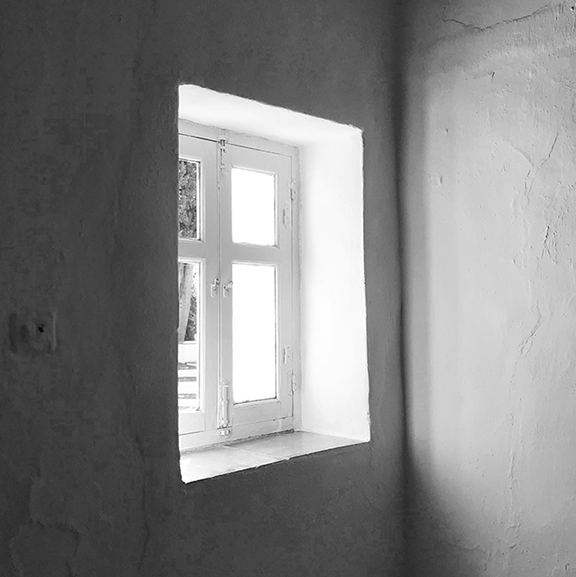
It’s not bright in my room but it’s cool with white stone walls and through my window, though not a large window, I can see the blue of the ocean expand before me. In the morning I can hear the sea birds and I have an unlacquered wooden table that faces the windowed wall and an equally old wooden chair, the seat polished and worn down from years of use. The floor is also stone, maybe wood — no stone. There’s thin linen sheets with delicate lace patterns on the bed, not the loose modern linen you get these days but the thick fibered heavy starched linen of your grandmother. On the floor there’s one shabby threadbare rug, I think of all the many people who once stepped on it, wherever it was — now only I step on it.

There I can breathe and I wear dresses and I smile at strangers and take the time to look people in the eye. Because there I’m whole and I can gently smooth out the impressions they leave on me — they don’t chip pieces of me away. I have so much to give and it pours out of me. Here I don’t mind the light, I live in harmony with it.

The way it dances in the morning rising over the water and quiets everyone around mid-day with its brilliance. Its firm, fiery hand on you in the afternoon — flattening you and forcing you to move slowly, methodically. It’s pressure which makes it impossible to rush. If you fight against it you will never win, only throw yourself into a tizzy of your own making — better to save face and accept your fate. So you wait and watch, and in the evening the shadows get longer and still you wait. Until the final hour and the dusk brings a tender melancholy of another day passed, another day coming soon to take its place. The relentless rhythm.

Here I rest lightly and freely. I can hear myself breathe and my hair is always thick and wild and full of sunlight and salt and emotions left to linger. Here they are allowed to stay, or go, just as they please.

It’s true before I had my room I had you. You weren’t much light but you beat the darkness. I liked your simplicity, like my room you were traditional, blank, and sparse really — straightforward. I didn’t have to hide and you let me be.

Your song, how did it go? The buffaloes? The delicate guitar picks and droning harmonica? “All roads lead to roam with the buffaloes. And the buffaloes used to say be proud of your name… be what you are… roam where you roam… do what you do. You’ve gotta have a wash but you can’t clean your name. You’re not called Jimmy you’ll be Jimmy just the same. The keys are in the bag in the chest by the door, and one of Jimmy’s friends has taken the floor.” We never figured out what it all meant.

Standard

Solitude: The invisible thread

“You live your life as if it’s real… The evidence accumulates that you’re not running the show. You still have to make choices as if you were running the show, but you make your choices with the intuitive understanding that it’s unfolding as it must… And if you can relax in that… if you can even touch it, or if it asserts itself from time to time, then the invincible defeat is transcended.”

– Leonard Cohen

I make it all perfect. I arrange my hair, slip into my black silk lounge dress and floral kimono, feminine and lovely. I spray my French perfume once on my chest and once at the nape of my neck, so my hair can soak it in. I count my calories and I wash my face, make sure the black from my mascara isn’t under my eyes. I clean under my fingernails and make sure my nails are shining and there are no nicks in my clear nail polish. I vacuum the floor and clean the mirror, no trace of dust bunnies or water marks. I put the food away in cabinet and wipe the counter. Put my shoes in the closet and hang my handbag with the latch closed. I sweep my balcony and empty the ashtray and straighten the chairs. I make my bed and dust the shelves, organize the books and magazines. I hang my coat and wipe my sunglasses clean for tomorrow. I shake out the bathroom mat and hang the towels neatly. I put my gold away in the little geometric Persian jewelry box. I listen to Bach and imagine I’m floating through the world, light as a feather and walking along an invisible thread, a set trajectory that nobody, including myself, can see — but we don’t decide, the piano keys do.

They bounce my thoughts up and down and suddenly I wonder why I’m alone. Then I remember I chose to be. All their faces, all their bodies and thoughts and movements, so big, so loud, so real, so imposing around me I can’t hear myself think. And when I can’t hear myself think I get dragged into the undertow without realizing. Then I wake up one day and I can’t think at all and I’m thrown this way and that and I don’t know which way is up anymore and I don’t remember where I came from. Not my home or where I live or lived but my center. The quiet of me alone in a dance studio late at night listening to my headphones spinning round and round for hours, walking at night with the cobblestones gleaming after a brief drizzle.

I come from the quiet, I always have. “Renata alone and quiet in her room,” my grandmother writes of me, a poem to describe each grandchild. I come from the quiet and the dark. I need the dark to find my way to the light within. When the sunlight comes in too harshly through the windows I can’t think, it’s just like when they’re around. I need the dark — quiet and gentle.

I’m from countless nights spent pacing back and forth starring up at the sky, that impenetrable limitless expanse of nothingness. Cursing the dawn, but always secretly waiting for it to arrive — to come and take away this burden — this empty weight of the silence and the dark closing in. But I need it, I never knew a sweeter lover than that weight, it never asked anything of me but to be there. It wanted me so badly it stole me away from everything else. It was never impressed by what I had or did, only who I was.

Sometimes I ask myself how this happened, how did I get so comfortable in the stillness, to crave so sharply the softness and quiet order I construct around myself my like a cocoon? Then I remember it’s always been this way. “The invincible defeat.”

I come from the secluded bench in a big damp European city park, much like any other. After I’ve run enough to exhaust myself I lay down on my back and stare up at the tops of the bare trees, black veins pulsing on a grey sky. I imagine them spinning around me, I’m the eye of the hurricane. My hands rest on my stomach and I’m panting. They are closing in on me, I imagine. But they’re not — just a foolish fairytale, delusions of grandeur. Life is not so simple.

I’m from those moments when one accidentally says something too revealing in a passing conversation, scaring themselves but still stealing a sideways glance at the other to see their reaction. That glance of hopeful terror. That glance that even if you feel it on you, the most loving thing you can do is to pretend you don’t notice it while taking the other’s vulnerability to heart, in stride.

I’m from that delicious lost moment when you jolt awake on a trans-country train and somewhere between sleeping and waking it takes you a bit too long to remember who you are and where you are and that you’re on a train and you’re a person and others expect to see you eventually and you’re on your way somewhere and why you’re going there. And you enjoyed those few brief moments of non-being bliss a bit too much and feel a pang of grief but then you glance at your phone and realize you’re still 30 minutes away from your destination — you have 30 more minutes to be a non-entity, so you feel your bones rest a little gentler in your cushioned window seat.

I’m from the river that the train runs along. Clear cold water, calm in its chaos, its constantly replenished impermanent yet perpetual existence.

I need to remember. If I don’t I forget the thread, I falter and the piano notes begin to feel like punches to the jaw. I need to remember, so I can touch it and transcend and every glance of vulnerability doesn’t have to be acknowledged and yet is absorbed none the less.

There will never be a sweeter lover than the night. But the burden of love is heavy, and while there is no greater reprieve than the darkness, only the dawn within can lift the weight. I need to remember.

Standard